
Behind the Curtain of CCC
By Cathy and Dan Smith, Capital Connectors
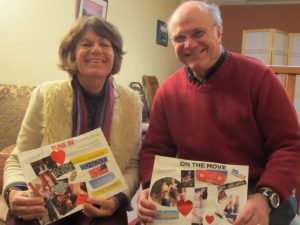 Phyllis Koch-Sheras and Peter Sheras helped to found CCC more than 30 years ago. How did it start? How did it evolve? And how do they feel about it now?
Back in the early 1990s Hugo and Vialla Mendez were each working on their Ph.D. dissertations. They were not making much progress. They had a friend, Carl Huber, who agreed to coach each of them on how to finish their dissertations. Carl was coaching them individually, and his wife Leah sometimes listened in.
At one point she said, “why doesn’t our couple coach their couple, rather than just you coaching each of them separately?” So they tried it. After a while they decided they could benefit from being coached as well and asked Hugo and Vialla to coach their couple about their own issues. So CCC began with one couple coaching another. That was the first coaching quartet.
This coaching as a couple worked so well that Carl and Leah invited a few other couples, including Phyllis and Peter, to join them in this activity.
From that point, a small community of couples gradually evolved. “And that’s when the Charlottesville Circle came into being,” Peter said.
“We knew right away that a couple was more powerful than the two individuals in it,” Phyllis said. “And then we began to see that the two couples together were actually more powerful than just one couple.” It became clear that quartets were the core of CCC.
Once they got into a quartet, they could see that the sum of the two couples was greater than just the force of one couple.
“It was probably five years later, when we were on the newly created CCC board, that it became clear that quartets were also more effective in leadership,” said Phyllis. “We could see that being in a quartet would be more powerful than just having a chairman-of-the-board couple or a president couple.
“When the executive quartet was created, things just started to take off.”
“It was a game-changer,” she continued, “the power of quartet.”
The expansion of CCC began when one couple moved and wanted to still be in quartet with other couples. Dick and Myrna Corson started the Columbus, Ohio, Circle. Into that circle came Doug Ferguson and Kate Husband, who threw themselves into the creation of a new circle every time they moved, which was frequently. They started the Seattle Circle, which grew so large they eventually had two circles. Hugo and Vialla moved to Atlanta and started a circle there.
This ‘migration model’ continued as CCC members moved to Texas, Michigan, Colorado and other places.
“That’s how Couples Coaching Couples became a national community,” Peter said.
“Then it occurred to the group that there was another way to expand besides the migration model,” said Peter. “Instead of moving to a place and starting a circle, we could choose a place and cultivate a circle there.”
“So we did that in Washington, D. C., where we had friends, and we explained it to them,” Phyllis recalled. “They really got it and invited Carol Herndon and Paul Bennet to join.” Then circles developed in Delaware, San Diego, Baltimore, New Jersey, Delaware and New York, among others. In order to include even more couples, expansion led to the development of virtual circles spearheaded by Lon and Sandy Golnick on the West Coast.
There are too many people to credit in this short article about the founding of CCC. Suffice it to say that many people with a passion for strengthening their own relationships and that of other couples led to the expansion of CCC over the last 30 years.
“Now the challenge is to keep growing and to attract younger couples,” Phyllis said. “The Ambassador Circle and other groups are committed to facilitating that growth.”
“We may be swimming upstream in terms of what technology does in the future, but face-to-face interactions continue to be important. We hope people continue to get together in person, such as we do at annual conventions,” said Peter. “That’s so important.”
“We really love the AA [Alcoholics Anonymous] model,” Phyllis said. “You know, that people could go anywhere in the world and go to a meeting.”
“We’d like there to be places all over the world where couples could actually talk openly about their relationship, without judgment. Because we live in an incredibly judgmental world.” Peter said.
“When we started CCC, we thought a lot about what it would look like 30 years later,” said Phyllis. “We even talked about Couples Coaching Couples in China.”
“The foundation has always been the same and is what makes it possible to create new circles,” she continued. “That is, being present for our coaches and doing our homework and supporting our circle.
“That’s been the foundation from the beginning. So we don’t have to reinvent the wheel every time we coach, or every time a new circle gets invented or created.”